Adrian Kulinski
Y2 Games Development
Project 1
Specialist Experimentation
As the games industry grows, studios are looking for people who have a broad understanding of game development and strong skills in a specific area. I’ve been selected by Quantum Loop to take part in a specialist development programme aimed at nurturing future talent.
Over eight weeks, I will rotate through four key areas: Games Design (with a focus on Level Design), 3D Art and Animation, Programming, and Audio Development. This will give me hands-on experience with industry-standard tools, software, and workflows in each field.
My role involves practical workshops, research tasks, and creative experiments. I’ll study the work of leading practitioners, analyse their contributions, and apply what I learn through small skill-building projects. This phase helps me discover my strengths and interests, guiding the direction of my future work.
This programme is a great opportunity to build a strong foundation in game development while helping me make informed choices about which specialism I want to focus on in more independent projects later this year.
Task 1
Practitioner Case Studies
To broaden my understanding of game development, I will explore how leading practitioners approach their craft. For this task, I will complete four mini case studies, each focused on a different specialist area: Games Design (Level Design), 3D Art and Animation, 2D Art and Animation, and Programming.
I will research one professional or studio per specialism, examining their creative intentions, use of visual and audio language, tools, and design processes. I will also consider how they present their work ethically.
By examining these practitioners, I will reflect on how their methods and philosophies can influence and improve my own skills. This will help me understand industry standards and inspire me to develop my creative practice in ways that are both thoughtful and effective.
3D Artist Case Study
Vincent Barbe
Vincent Barbe has worked for studios such as Wonderstorm (The Dragon Prince: Xadia) and Silkroad Studios (Yokai Tales: Fox) as a 3D environment artist. He contributed level art and models for both TDP:X and YT:F during his time at each respective studio. He began his journey by studying at two 3D art schools (Artside and New3dge) after high school, the former of which inspired him to focus on environmental design as a career rather than a pastime. For an assignment at Artside, he was inspired by Studio Ghibli, Zelda: BotW and Xenoblade when making an environment that could fit into a video game.
Programmer Case Study
John Carmack
John Carmack used to be a co-founder, CTO and lead programmer for id Software, who made projects such as the Commander Keen series, the original Doom series and the Quake series, though Carmack only worked on Quake I, Quake II and Quake III arena before leaving the company in 2000. Following his departure, he decided to found his own company by the name of Armadillo Aerospace, which specialised in aerospace and promptly was put into “hibernation” in early 2013 following a slight harsh landing in their STIG-B’s third launch. Not long after, Carmack found himself in the position of CTO at Oculus VR (now Reality Labs) where he worked on mainly mobile VR headsets such as the Samsung Gear VR and Oculus Go.
2D Artist Case Study
Name Here
Early Career
Ikumi Nakamura began her career at Capcom as an environment artist.
She became well known for working on Ghostwire: Tokyo.
Founding Unseen Inc.
She started her own studio because of her health issues causing her to leave her previous.
“Borderless studio” means a studio where team members could co-operate remotely, rather than coming to Japan.
Studio Culture
Unseen Inc. is different from other Japanese studios because Unseen maintains a more relaxed stance on hierarchy, based more so on mutual respect than a strict power structure.
She prefers to hire generalist developers rather than specialists because they allow for more flexibility and tend to have more experience.
Leadership & Teamwork
A lesson she learned from her mentors (Kamiya especially) is to be "wild", in a way that grabs attention, whether that be publishers or fans.
She wants her team to feel comfortable and considered when working together, especially women (who are incredibly underrepresented in Japan's game market).
Challenges & Growth
One challenge she faced in her career was being forced to leave a project halfway through due to health issues.
From that experience, she learned that, though leaving the project itself felt terrible, she was able to trust the team to help the project grow and mature into a full-fledged game (largely in part due to her ability to delegate and move on).
Current Work
Her new game is called Kemuri and it’s about challenging stylised depictions whilst creating an absurd, grandiose cheerful comedy with a touch of seriousness.
The tone or feeling of the game is a unique opportunity compared to her past work.
Reflection
What inspires me most about Ikumi Nakamura is her drive to improve.
Her story shows that to succeed in games, I should know how to grab the right kind of attention.
Level Designer Case Study
Malin Wong
Malin Wong is a level designer at the Avalanche Studios Group, who have created community favourite games such as the Just Cause series and the theHunter series and collaborative projects with industry giants such as Warner Bros. Games, who published the Mad Max game which ASG developed. She began her journey into the industry by enrolling into Futuregames, a well-known game development and technology school, during which she partook in group projects such as The Black Rose, Summit and Junkyard Bash, which are all relatively well received on itch.io.
Task 2
Experimenting with Specialist Tools
After analysing practitioner work, I will experiment with specialist tools, materials, and processes across the four fields: Games Design (Level Design), 3D Art and Animation, 2D Art and Animation, and Programming.
I will create work such as grey-box level production and small cutscenes for Games Design, character sculpting, rigging, and keyframe animation in 3D, sprite sheets and concept art in 2D, and class-based scripts in Programming. My focus will be on the experimentation process rather than finished outcomes.
I will document my progress in a time- and date-stamped development diary on WIX, including visuals to show what I have attempted. I will explain in each entry how I used the tools, how my approach reflects professional practices, and how I followed ethical guidelines. I will also reflect on whether I am satisfied with my outcomes and note ways I could improve or refine my work. This process will help me build skills while linking my experimentation to industry standards and creative intent.
3D Art Experimentation
Level Rebuild Task
The initial week back to college, we were tasked with recreating a level (in 3D) from a game (2D OR 3D) in order to refresh our skills in modelling.
I decided to tackle this problem by using a website by the name of noclip (noclip.website) in order to browse an array of levels that I may be interested in recreating for this project, eventually finding the SpongeBob Squarepants: Revenge of the Flying Dutchman which seemed interesting.
After perusing the range of levels at my disposal, I settled on recreating the iconic Krusty Krab as it seemed like a relatively simple space that I would be able to recreate despite my hiatus weakening my skill in the subject.

Image 1 - Interior of the Krusty Krab from SpongeBob Squarepants: Revenge of the Flying Dutchman via noclip.website

Image 2 - Exterior of the Krusty Krab from SpongeBob Squarepants: Revenge of the Flying Dutchman via noclip.website
After deciding on which level to recreate, I made a blockout for the main building in Blender, making sure to create separate object for the windows.

Image 3 - My vague blockout made in Blender
3D Art Experimentation
Plane model in Blender (PowerHour)
This week, in order to experiment with Blender as a software for 3D artists, I was tasked with making a model and animation of a plane using a given tutorial. Upon following this tutorial, I ended up creating a plane which flew up and down, with the only real challenge being some of the curvature being tough to get right, which I resolved by deviating slightly from the tutorial and experimenting until I found a design I thought looked better.
This task helped me to understand some Blender mechanics that were outside of my entry-level skills including a further understanding of animation which allowed me to further develop myself as an all-rounder in games development as a whole.

Image 1 - My Blender plane model

Image 2 - My Blender plane model's keyframes
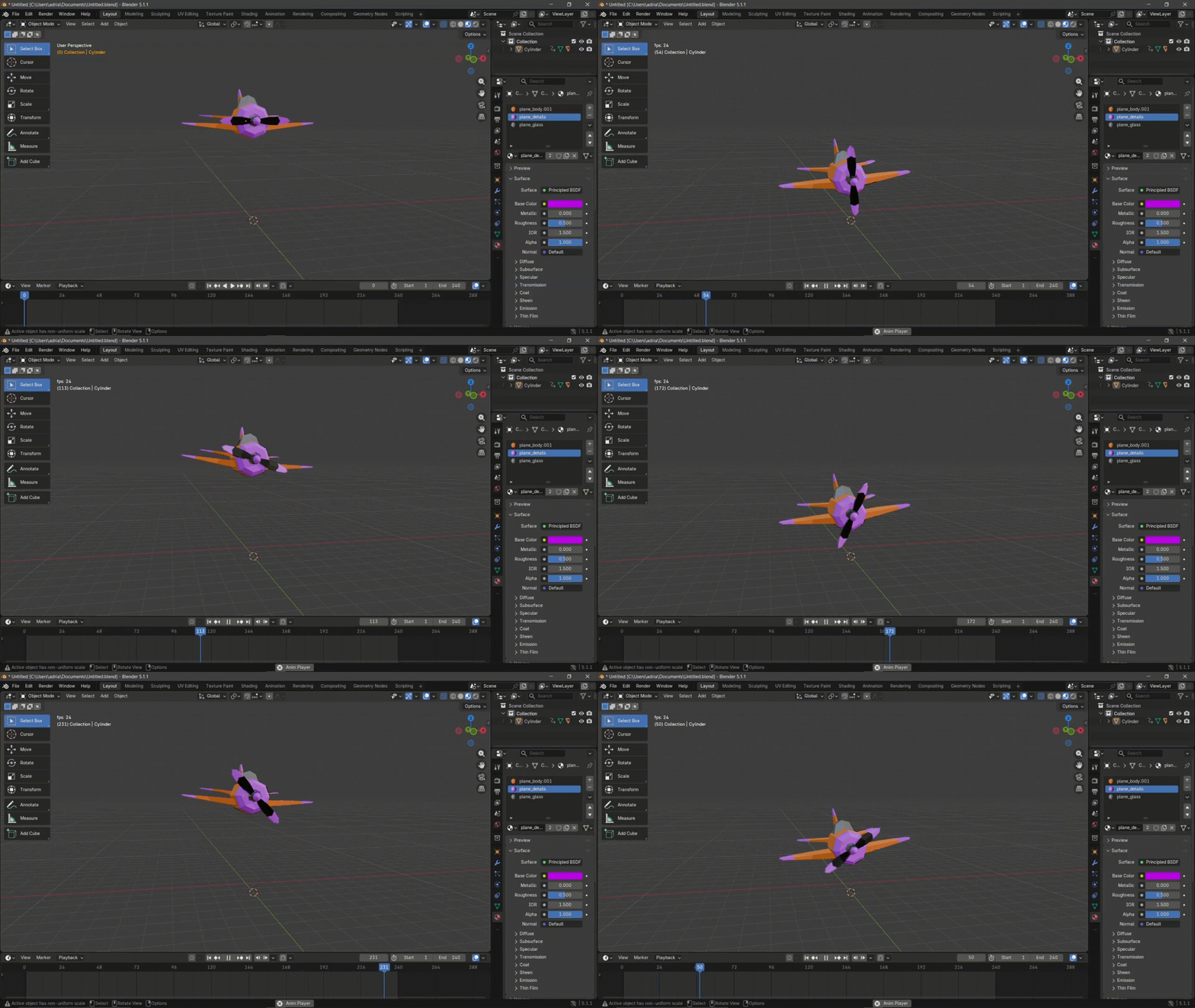
Image 3 - My animated Blender plane model
Level Design Experimentation
Developing a FPS Map design
Throughout this week, I designed an initial sketch for a potential map in an FPS game, including two possible objective sites which can be tackled by the attackers. I explored how to keep maps balanced and still remaining fun for all players. I discovered how to use the props in order to give the map some character, taking a large amount of inspiration from Valorant maps such as Bind.
This inspiration is especially clear with the map's layout, featuring two distinct halves separated by some form of geometry or structure in the middle. Throughout this activity, I managed to explore a variety of things, including the importance of a well-designed map to the users' experiences. One thing that I struggled with during this task was my lack of understanding when it came to FloorPlanCreator's elevation system, such as ladders and stairs. This made it difficult to attempt any sort of advantageous positioning plans for either team.

Image 1 - My annotated map design
Programming Experimentation
Developing a maze game in UE5
Whilst setting up my first Unreal project back at college, I relearned how to manipulate the camera, including changing the camera speed, the height of the camera and how to move the camera effectively and efficiently. This allowed me to work on my level without much difficulty as I'm able to manoeuvre throughout the level and ensure that the level both looks good and functional from any and all angles, keeping an eye out for things such as unwanted holes in corners, gaps in walls where they aren't need or incorrect props in places that woudn't fit.
Alongside this, I managed to explore the outliner in the right of the engine, which allowed me to change the properties of objects I selected, including the likes of size, rotation, scale, material and even the physics of the object(s) selected. This is useful as it enables me to manipulate how the objects in my level interact with both each other and the terrain that I have made. Using this, I'm able to ensure that the interactive parts of the level don't break because of any unwanted interactions between each other.


Image 1 - My player camera blueprint

Image 3 - My arrow shooter blueprint
Image 2 - My player arrow collision blueprint
Task 3
Evaluating Experimentation
To support the allocation of roles for our upcoming studio project, I will create a critical evaluation reflecting on my development over the past eight weeks. I will highlight my strengths, interests, and potential specialisms I might want to focus on.
I will summarise my engagement with specialist tools, materials, and processes explored during the project. I will critically assess my practical outcomes and identify the specialism I found most engaging, explaining why it stood out to me. I will also consider how effectively my work communicates creative intent, purpose, and visual language.
I will reflect on how my experimentation has improved my understanding of the games development pipeline and how this insight will shape my approach to future projects within my chosen specialism.
I will document and publish all of my evaluations on my WIX portfolio to track my progress and share my reflections with others.
Project 1 Evaluation
Personal Development
-
What have been your key strengths over the past eight weeks?
I believe that a key strength of mine would be my engagement with a majority of the content, especially in regards to the exploration in Unreal Engine.
-
Which areas of game development have you enjoyed the most and why?
The area I enjoyed most would have to be the programming section of this project due to its roots in logical processing and mathematics, both of which have been pre-existing interests of mine before ever enrolling in this college or beginning my course.
-
Which areas have you found more challenging, and how did you address these challenges?
Personally, I believe that the 3D level recreation was my weakest part of this project due to the sheer amount of time I spent attempting to make the models perfect. To combat this, I began to think realistically rather than expecting every slight element to be completely and absolutely perfect.
Engagement with Tools, Materials, and Processes
-
What specialist tools, software, or materials have you used?
Over the course of this project, I've used Blender, the Floorplancreator website, the Pixilart website and unreal engine.
-
How have you applied these tools and processes in your practical work?
I used Blender for the recreation of a level and the plane model (3D art experimentation), floorplancreator for the level design experimentation, pixilart for the 2D art experimentation and unreal engine for the programming experimentation.
-
How do your methods compare to professional practices in the industry?
I believe that my methods are comparable quite well to industry practices, due to Blender and Unreal Engine both being tools used professionally by studios all around in order to produce professional content.
Assessment of Practical Outcomes
-
What projects or outcomes have you produced during this period?
Throughout these 8 weeks, I've managed to explore 3D art, 2D art and the programming side of games development through recreating a 3D level, creating a 3D plane model, converting 3D characters into 2D sprites and creating something akin to a trap in Unreal Engine.
-
Which specialism did you find most engaging, and why?
I personally found the programming specialism the best fit for me due to the basis of logic/mathematics, both of which I had already been a fan of prior to my exploration of the field.
-
How effectively do your outcomes communicate creative intent, purpose, and visual language?
I believe that most of my outcomes successfully show my intent, as well as the purpose with with each aspect was made.
Reflection and Future Planning
-
How has your experimentation improved your understanding of the games development pipeline?
This project helped me understand the games development pipeline through expansion of my understanding of each separate role that helps with a game's creation, and therefore the associated time required for each element. This is helpful to know as it enables me to ensure level-headedness during moments of crisis (due to my extensive understanding) as well as ensuring that I'm working at a synchronous pace alongside the members of my team.
-
How will your experiences shape your approach to future projects?
I believe that this project helped be explore the various areas of game development again, reinforcing my love for the programming aspect of the course even further. Due to this, I believe that I'm likely to focus on that side of game development for my future projects.
-
What skills or techniques do you plan to focus on developing further?
I think that I would like to pursue the programming specialism in the future, largely due to my early preference in it likely being able to bloom into a much better, well-developed talent if properly tended to.